
( your situation · expat, newcomer )
RENTAL APPLICATION IN FRANCE as an expat or newcomer :
RENTING without a French history
You are moving to France, or moving back after years abroad, and everything is missing at once: no French tax notice, no payslips in euros, no guarantor in the country, sometimes no address yet. Landlords see foreign documents they cannot read and move on to the next file. Yet French law provides for your case, and a well-built rental file (dossier de location) fills every gap with the right document. Here is what to provide, how to present it, and how La Maraisienne prepares it in 10 minutes.
Why French landlords hesitate with newcomers
A French landlord has three reflexes: check the tax notice (avis d’imposition), call the employer, and make sure a guarantor (garant) in France will pay if you do not. When you arrive from abroad, all three fail: your tax notice is American, German or Canadian, your employer is in London, your guarantor lives in Montreal. Add unpaid rent insurance (GLI), where many policies require income taxed in France or a resident guarantor, and an agency sets your file aside without opening it.
What landlords often do not know: the decree that fixes the list of documents explicitly says a foreign tax notice replaces the French one when income was taxed elsewhere. A non-resident guarantor is legal. And public and private guarantee schemes exist precisely for you. Your file must tell them so, in French, simply.
Documents to provide when you arrive in France
Decree no. 2015-1437 of 5 November 2015 fixes what a landlord may ask for. Here is how each document is filled when you have no French history yet.
| Document | Status | How to provide it without a French history |
|---|---|---|
| ID: passport, ID card, residence permit (titre de séjour) or long-stay visa | Required | A passport is enough. If you have a permit or visa, attach it: it reassures about the length of your stay. |
| Proof of address (justificatif de domicile) | Required | Latest rent receipts from your home abroad, or a host certificate (attestation d’hébergement) if staying with someone, or a hotel or short-term furnished rental invoice. |
| Proof of professional situation | Required | French employment contract (even if it starts next month), job offer letter, transfer letter from your employer, foreign contract if you work remotely, enrolment certificate if you are a student. |
| Proof of income: last 3 payslips | Required | Your foreign payslips are fine. Add a line with the conversion into euros. |
| Tax notice (avis d’imposition) | Required | The decree accepts the tax notice of the country where your income was taxed. Attach it with a simple translation of the key lines (annual income, tax paid). |
| Proof of previous rent payments | Recommended | Receipts or a payment statement from your previous landlord, even abroad: it is proof that you pay. |
| Bank letter stating your savings balance | Recommended | Allowed (it is not a bank statement). For a file with no history, it is often the decisive argument. |
What cannot be asked of you: bank statements, certificate of no outstanding credit, direct debit authorisation, medical records, criminal record, reservation cheque, or a sworn translation (service-public F1169).
What actually makes the difference
Having the right documents is necessary, not sufficient. Newcomer files that get accepted share five things.
Translate before anyone asks. A simple (not sworn) translation of the essential lines of each foreign document: nature of the document, amount, period, in euros. The landlord will not look for a currency converter. A foreign file that reads easily in French beats an average French file.
A net monthly income in euros, at the top of the presentation. Converted at today’s rate, with the source. If it covers three times the rent, say so.
A guarantee is the key. An individual guarantor in France if you have one. Otherwise Visale: free, open to everyone up to age 30 whatever your nationality, provided you hold a valid residence permit, and beyond 30 under conditions (notably for some employees starting a job). Otherwise a paid guarantor service (GarantMe, Cautioneo), whose business is precisely this. With a guarantee, the lack of French history stops being a problem. Guarantor, Visale, GarantMe: how it works
A presentation that tells your arrival. Three to five lines: where you come from, why you are arriving (job, studies, family), for how long, and your financial situation in one sentence. The landlord wants to know whether you will still be there in two years. Tell them.
Explain the decree in one sentence. “As my income was taxed in [country], I attach my [country] tax notice, as provided for by the decree of 5 November 2015.” It changes how the agency looks at the document.
What a good newcomer file looks like
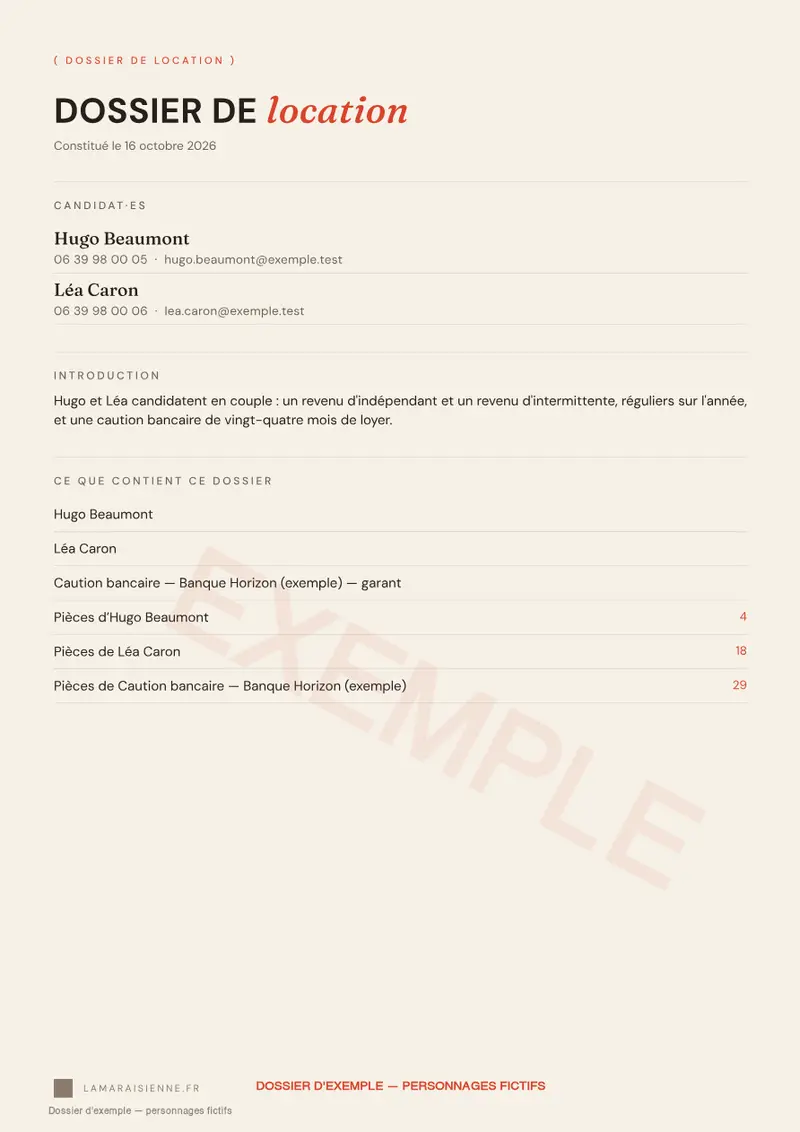
La Maraisienne’s Atypique sample shows the structure: a presentation page that explains the situation and gives the monthly income in euros, then the documents in the order of the decree, labelled in French with the foreign equivalent in brackets. One PDF, readable in two minutes by a Paris agency.
How La Maraisienne helps
The Atypique plan (€24.90 per month, no commitment) includes the “foreign documents” flow: the site tells you which foreign document replaces which French one, the AI writes your presentation in French from what you tell it (in French or in English), and the final PDF is in French, because a French landlord will read it. You can update it as soon as you get your first French payslip or your guarantor. See the plans
La Maraisienne does not list apartments and does not connect you with landlords. We prepare your file; you send it to the listings you choose.
Other situations: Freelancer · Performing arts worker
( FAQ )
Frequently asked questions
I have no French tax notice. What do I do?
Provide the tax notice of the country where your income was taxed: the decree of 5 November 2015 explicitly provides for it. If you have none at all (first job, country without tax notices), explain it in the presentation and compensate with your contract, payslips and a guarantee.
Do my documents need a sworn translation?
No, a landlord cannot require one. A simple translation of the key lines, done by you, is enough and saves everyone time.
My guarantor lives abroad. Is that accepted?
Legally yes. In practice many landlords prefer a guarantor in France because they are easier to pursue in case of unpaid rent. If your guarantor is abroad, back them up if possible with Visale or a paid guarantor.
Is Visale open to foreigners?
Yes, up to age 30, whatever your nationality, with a valid residence permit. Beyond that, eligibility depends on your professional situation: check on visale.fr.
I do not have a French address yet. What proof of address can I give?
Rent receipts from your previous home abroad, a host certificate if you are staying with someone, or the invoice of your temporary rental or hotel. Simply say in the presentation that you are arriving.
My French employment contract starts next month. Can I already apply?
Yes. Attach the signed contract or the job offer: it is a document provided for by the decree and often the most reassuring one in your file.
Can I also use DossierFacile?
Yes. DossierFacile is the free French government service that checks your documents, foreign ones included. La Maraisienne writes your presentation and designs the file. The two complement each other.